
BUYING GUIDE
What to Include in a Custom Bag RFQ
A clear request for quotation gives a manufacturer the information needed to evaluate material, construction, branding, quantity and production requirements accurately.
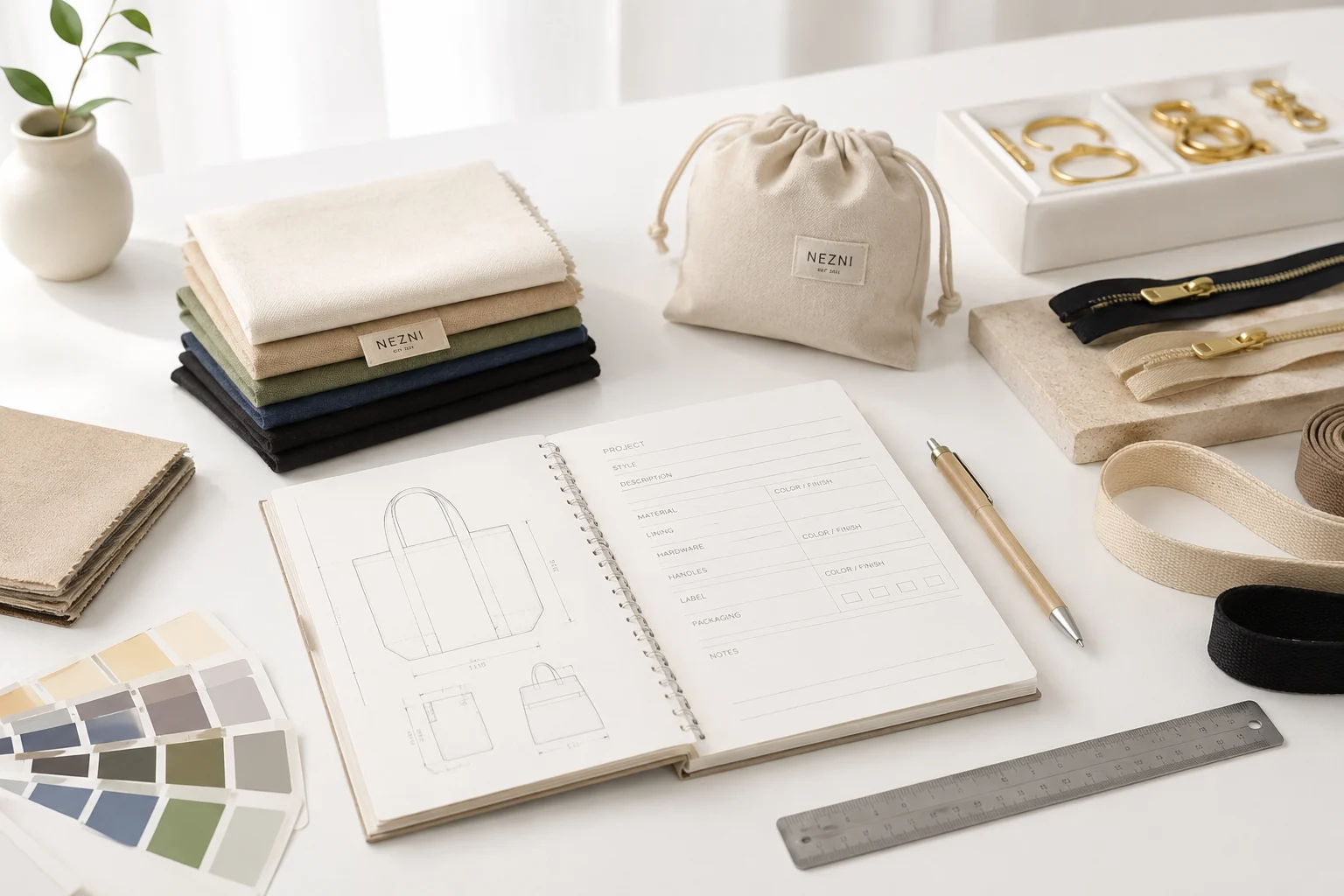
A custom bag RFQ does not need to be a long technical document. It does, however, need to give the manufacturer enough information to understand what is being requested and which parts of the specification still need to be developed.
The clearer the initial brief, the easier it is to compare quotations on a like-for-like basis. Missing dimensions, unclear material expectations, incomplete artwork or an undefined order quantity can lead to assumptions that make quotations difficult to compare and may create avoidable revisions during sampling.
For procurement teams, agencies, distributors and brands, the most useful RFQ combines commercial information with the core technical requirements of the bag.
RFQ BLUEPRINT
1. Define the Bag and Its Intended Use
Start by explaining what type of bag you need and how it will be used. A simple description such as “promotional tote for an exhibition” or “reusable shopping bag for a supermarket programme” immediately gives the manufacturer useful context.
Intended use affects material selection, carrying capacity, handle construction, finishing and the level of durability that should be built into the product.
If you already have a reference product, technical drawing or previous sample, include it. A clear visual reference can reduce ambiguity, but it should be accompanied by dimensions and the changes required for the new project.
2. Provide Dimensions and Construction Details
Bag dimensions should normally include width, height and gusset depth where applicable. If the bag has a bottom gusset, side gussets, flap, pocket, zipper or other structural detail, indicate this in the brief.
If the exact dimensions are not yet final, state the approximate size and intended contents. This is more useful than leaving the size completely undefined.
3. Describe the Material Requirement
If a material has already been selected, include the material type, preferred weight or specification, colour and any required surface treatment or lamination.
If you are not sure which material is suitable, do not guess. Describe the expected appearance, load, use and target positioning instead. A manufacturer can then propose appropriate cotton, canvas, nonwoven, PP woven, polyester or other material options for evaluation.
Where required, material sourcing can also be aligned with project-specific compliance or certification requirements. OEKO-TEX certified materials can be sourced according to project requirements.
4. Include Artwork and Branding Requirements
Branding information should be supplied as early as possible because artwork can influence material choice, print method, panel construction and sampling.
Provide vector artwork where available and indicate approximate print size, number of colours, placement and whether the design requires a simple logo print or extensive surface coverage.
If the artwork is still being developed, send a temporary reference and state that final artwork will follow. This allows the quotation to progress without presenting provisional artwork as final production information.
5. State the Estimated Order Quantity
Quantity is essential for an accurate quotation. Material purchasing, printing setup, cutting, sewing, heat sealing, packing and other production steps can all be affected by volume.
If the final quantity has not been approved, provide a realistic estimate or ask for quotation levels such as 1,000 / 2,500 / 5,000 units. Tiered quantities can help procurement teams understand how volume changes the commercial structure of the project.
Avoid requesting a quotation without any quantity indication. The same bag specification can have very different production economics at low and high volumes.
6. Clarify Packaging and Delivery Requirements
Packaging should be included when it affects the project. Individual polybags, bulk packing, carton requirements, barcode labels or other retail preparation can change both production handling and cost.
Include the delivery country or destination city where possible. This does not replace a final freight quotation, but it gives useful context for packing, carton planning and order coordination.
If there is a target delivery date, state it as a target rather than assuming a production lead time before the specification and quantity have been reviewed.
7. Explain Your Sampling Expectations
For custom manufacturing, sampling is often the point where material, dimensions, printing, construction and finishing are confirmed together. The RFQ should indicate whether a physical sample will be required before bulk production.
If a reference sample must be matched, specify which details are critical and which can be adapted. This prevents a manufacturer from assuming that every component of the reference product must be reproduced exactly.
Common RFQ Mistakes to Avoid
Only Sending a Photo
A photo can communicate style, but it does not define dimensions, material weight, construction or quantity.
No Quantity
Without an estimated order quantity, the manufacturer cannot evaluate production economics accurately.
Undefined Material
If material is uncertain, explain performance and appearance requirements instead of selecting an arbitrary fabric.
Incomplete Artwork
Print coverage and artwork complexity can affect both process selection and quotation accuracy.
A Practical Custom Bag RFQ Checklist
Before sending the enquiry, check whether the following information is included. Not every project will have every detail finalised, but the manufacturer should be able to see what is confirmed and what still requires recommendation.
What Happens After the RFQ Is Submitted?
A useful RFQ allows the manufacturer to review the project systematically rather than filling gaps with assumptions. The next stage normally involves clarification, material or construction recommendations where required, quotation preparation and then sampling once the commercial direction is agreed.
- Project review: dimensions, material, construction, artwork, quantity and delivery requirements are checked.
- Clarification: missing or conflicting specifications are resolved before pricing or sampling.
- Quotation: the proposed specification and commercial terms are prepared for review.
- Sampling: a physical sample can be developed to confirm the product before bulk production.
A strong RFQ does not need to answer every technical question in advance. Its purpose is to give enough accurate information for the manufacturer and buyer to develop the specification efficiently and evaluate the project on the same basis.